Soft Skills: Innate or Acquired?

Are we born with soft skills, or do we learn them?

Is a leader born or made? This question has always sparked debate in education, business, and psychology. Competencies such as empathy, resilience, or leadership — are they innate talents or abilities that anyone can develop through practice?

Science now offers solid answers: although genetics has an influence, the environment and constant training can substantially shape and improve our socio-emotional abilities.

The influence of genetics on soft skills

Personality psychology — from the pioneering work of Lewis Goldberg that shaped the Big Five (OCEAN) model — shows that there is a hereditary component in our basic traits.

What do studies say?

Research with twins indicates that around 40–60% of the variation in traits such as extraversion, agreeableness, or openness is explained by genetic factors. This means we may be born with predispositions. For example, someone may have a naturally more empathetic or more introverted temperament depending on their genetics.

Neuroplasticity and training: the other half of the story

However, heredity is not destiny. The influence of environment, education, and experience is equally — or even more — important in shaping our soft skills.

The human brain has extraordinary neuroplasticity. It can create and strengthen new neural connections throughout life in response to learning and practice. This means that even abilities with a biological basis can be developed through appropriate training.

Practical examples

A personality trait such as extraversion may facilitate interpersonal communication, but an introverted person can also become an excellent speaker if they train public speaking and social skills in supportive environments.

Similarly, individuals who are naturally less empathetic can increase their empathy through perspective-taking exercises, mentorship, and frequent contact with diverse realities. Neuroscience has shown that deliberate practice of compassion and empathy produces functional changes in the brain — activating “synchronization” circuits between people — which strengthens empathetic capacity over time.

Openness to experience (curiosity, imagination) can predispose someone to creativity, but creativity can be cultivated. Exposing a person to novel challenges, brainstorming techniques, art, or open-ended problem solving tends to improve their creative thinking. In fact, decades of research on creativity training confirm measurable improvements in creative performance among trained individuals. A recent meta-analysis found moderate but significant positive effects after training programs, demonstrating that “creating” is also learned with the right strategies.

In summary: genetics and environment

Soft skills are not completely “written” in our genes. Genetics sets a starting point, but the final development of our socio-emotional abilities depends largely on education, practice, and the experiences we accumulate.

No one is “born” knowing how to lead or manage stress; these are competencies forged through interaction with others, facing challenges, and reflecting on them.

Dr. Beatriz Abad, psychologist and researcher in Human AI R&D projects, summarizes it this way: “Although some people possess these abilities naturally, everyone can develop them with the right training… with proper education and a supportive environment, anyone can cultivate the skills they need.”

In other words: soft skills are “made more than born,” as long as motivation and learning conditions exist.

Are all competencies trainable?

The short answer is yes: every socio-emotional competency can be improved through practice. However, there are nuances in how they are trained and how long it takes to see change:

Competencies that improve quickly

Specific and situational soft skills — such as active listening, time management, or public speaking — tend to show noticeable improvements within weeks when practiced intentionally.

A professional may refine their ability to give constructive feedback after a short course and some supervised practice. A student may learn collaborative study techniques or mindfulness in a single term and improve self-regulation of stress.

Competencies that require more time

More complex competencies — such as resilience, leadership, or an innovative mindset — require more time and, above all, real experiences in which to apply them.

Resilience, for example, is strengthened by progressively overcoming difficulties, reflecting on setbacks, and seeking support from mentors; it is not something acquired from reading a manual, but by experiencing challenges with proper guidance.

Forming an effective leader involves theory, personalized coaching, and opportunities to lead projects in safe environments where they can make mistakes and learn. These types of abilities develop over months or years, with continuous on-the-job learning.

The key: measurement + feedback + continuous practice

Successful initiatives tend to follow this pattern:

  1. Evaluate the initial level of the competency (360° questionnaires, personality analysis, or AI-based assessment such as Human AI).
  2. Offer specific feedback on strengths and areas for improvement.
  3. Implement a plan of deliberate practice (exercises, training, mentorship).

This cycle does not occur only once, but repeatedly. Organizational research confirms that leadership training programs work. On average, they produce substantial improvements in trained leaders’ behaviors and outcomes. But results endure only when training is reinforced through periodic practical application and continuous feedback.

The Human AI approach: measure to improve

At Human AI, we observe that all soft skills can be developed if the right environment is created. We have applied educational programs in which, after rigorously evaluating individuals’ socio-emotional competencies, personalized improvement and support plans are designed.

With this approach, abilities such as communication, collaboration, or emotional regulation flourish even in profiles where they were initially underdeveloped. A low starting point is not a definitive sentence. With a clear itinerary, positive changes in behaviors and attitudes are real and measurable.

Given that soft skills are both crucial and malleable, at Human AI we have committed to an artificial intelligence–based solution to evaluate and develop them objectively, quickly, and personally.

How does it work?

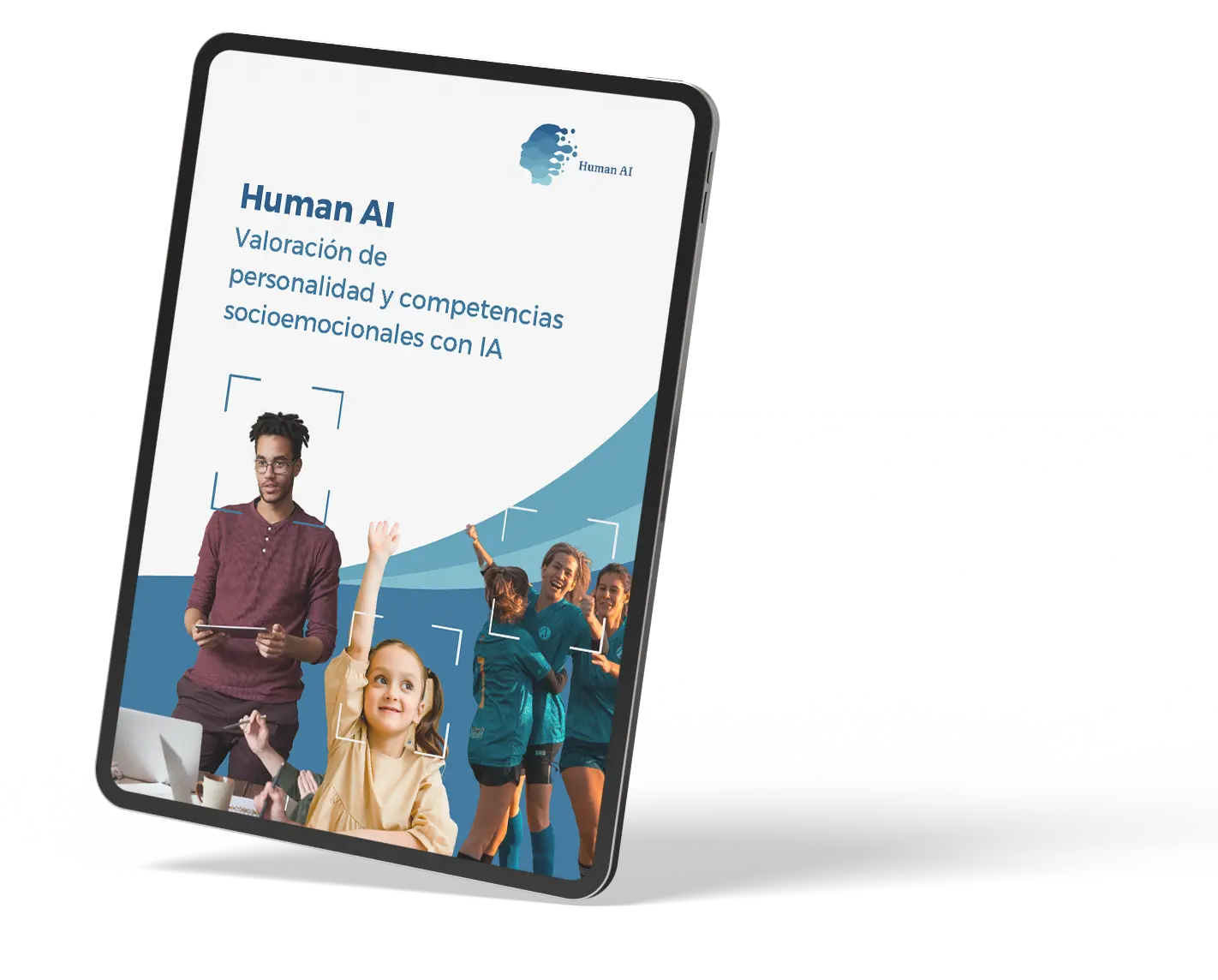
Our technology combines AI algorithms with principles of psycholinguistics to analyze natural language and extract indicators of personality and socio-emotional competencies. Instead of relying exclusively on traditional tests or questionnaires, the system can evaluate more than 35 competencies from texts written by the person (for example, a free essay or responses to open questions), obtaining objective results without long testing procedures.

Thanks to language-processing models trained to recognize subtle linguistic patterns associated with distinct traits and abilities, certain words, expressions, and structures in our speech reveal — for example — levels of empathy, resilience, or collaborative thinking. By analyzing these patterns, Human AI “translates” words into data, and this data into personalized reports. In other words, it turns any written response into a quantified socio-emotional profile.

Advantages of this approach

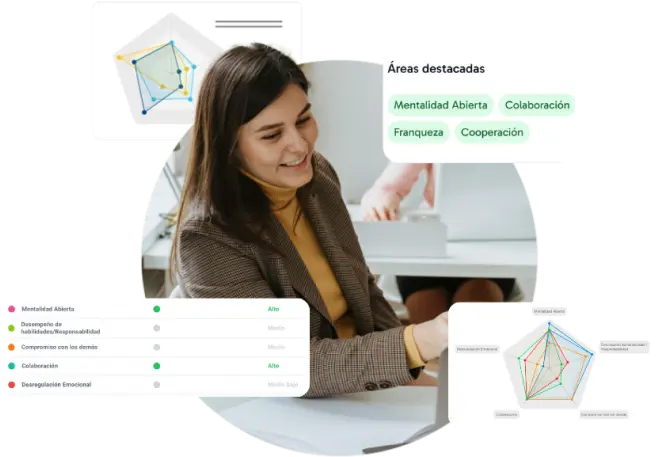
The analysis is immediate and free from some typical biases of human evaluation (such as conscious or unconscious evaluator prejudice). Moreover, it is performed in context — using content generated by the student or professional — which allows a more dynamic assessment grounded in each individual’s reality. The results include strengths, areas for improvement, and practical recommendations for each person.

For example, a report may reveal that a certain student excels in critical thinking and curiosity (strengths) but shows improvement areas in emotional regulation and empathy; from there, concrete activities are suggested to work on these (mindfulness guidelines, focused tutoring, classroom role-playing dynamics, etc.). This objective and actionable information helps prevent future difficulties in academic performance, students’ socio-emotional well-being, and even vocational guidance.

Practical applications

The Human AI approach has been validated in both educational environments (secondary schools, universities) and corporate human-resource settings.

School tutors and counselors now have scientific data about students’ socio-emotional competencies, enriching personalized guidance: they can detect early which students may need extra support in, for example, resilience or self-esteem, and implement interventions before those deficits affect their results or lead to school dropout.

In the business world, talent-management teams use the tool to identify employee potential beyond what their CV states. An internal leadership candidate, for example, can be objectively evaluated in key competencies (emotional intelligence, strategic thinking, etc.) and personalized development plans can be designed to prepare them for managerial roles.

Human AI reports thus facilitate strategic decision-making based on data, both in educational centers and HR departments, connecting socio-emotional profiles with adequate training and promotion initiatives. In summary, we provide practical insights to convert talent into real impact, aligning people’s development with educational and labor-market needs.

Conclusion: from potential to action

In today’s era, soft skills are no longer optional or “complementary”: they are the foundation of innovation, employability, and personal and collective well-being. As automation advances, intrinsically human abilities — creativity, empathy, critical thinking, collaboration — will make the difference.

The good news is that we are not chained to the dispositions we are born with: we can continually develop.

If you can measure it, you can improve it; and if you can improve it, you can transform how you learn, work, and lead.

Technology and science give us the tools to put this into practice. Understanding and cultivating socio-emotional competencies is key to turning talent into real impact, especially in a world where emotions directly influence professional performance, employability, and mental health.

Thanks to advances such as artificial intelligence applied to education and people management, the question is no longer “Are soft skills born or learned?” but “How are we going to develop all that human potential?” Every student and every professional has a wide margin for growth in their soft skills if we provide the right feedback and support.

Ultimately, investing in soft skills is investing in the future: in our organizations, our communities, and ourselves as ever-evolving individuals.

If you want to turn “words into action,” we invite you to measure and strengthen your team’s or students’ soft skills with our tools. Request your free demo and discover how Human AI can reveal the hidden socio-emotional profile and catalyze its development toward new levels of success and well-being.